GST confuses a lot of new sole traders because it feels like it should affect your income tax somehow — and it doesn’t, at least not directly. Here’s what GST actually is, when you need to register, and why it isn’t really “your” money in the first place.
The $75,000 threshold
You must register for GST once your turnover reaches $75,000 in a 12-month period (or you expect it to). Below that, registration is optional — some sole traders register voluntarily anyway, usually because their clients are GST-registered businesses who’d prefer an invoice they can claim GST credits on, or because the trader wants to claim GST credits on their own business purchases.
GST isn’t your money
This is the single most important thing to understand: GST is a tax on the sale, collected from your customer and passed through to the ATO — it was never your income to begin with.
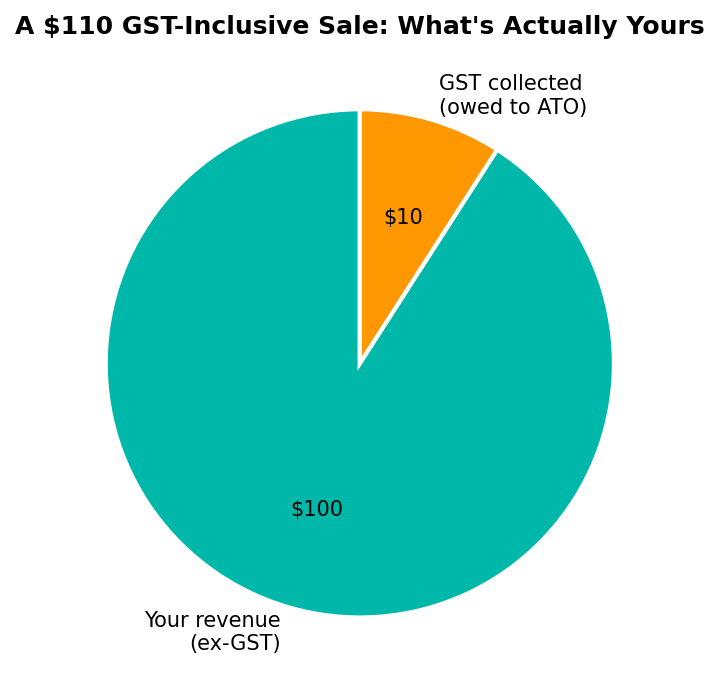
On a $110 GST-inclusive sale, $100 is genuinely your revenue and $10 is GST you’re holding on the ATO’s behalf, due at your next Business Activity Statement. Treating that $10 as available cash — spending it, or not setting it aside — is the single most common way small businesses end up with a nasty surprise at BAS time.
GST and income tax are entirely separate systems
Your GST turnover doesn’t directly affect your income tax bracket, and your income tax calculation doesn’t touch GST. If you’re registered, you file a Business Activity Statement (monthly, quarterly, or annually depending on your turnover) reporting GST collected and GST credits claimed on business purchases, separately from your annual income tax return (which reports your profit, GST-exclusive).
What registering actually involves
Once registered, you must charge GST (currently 15% is New Zealand’s rate — Australia’s rate is 10%) on your taxable sales, issue tax invoices showing the GST component, lodge BAS on your assigned cycle, and remit any GST collected minus any GST credits you’re entitled to claim on business expenses. This is genuinely more administrative overhead than staying unregistered — which is exactly why many sole traders under the threshold choose to stay that way until growth forces the decision.
Claiming GST credits
The upside of registering: you can claim back the GST you pay on business purchases — equipment, supplies, professional services — as an input tax credit, effectively getting that 10% back rather than absorbing it as a cost. For a business with significant equipment or supply costs, this can meaningfully offset the administrative burden of registration.
Our sole trader calculator works from your profit figure (turnover minus expenses) directly — GST doesn’t factor into your take-home calculation at all, exactly because it was never your money to take home.