If you’ve ever looked at your payslip and wondered exactly how the Australian Taxation Office arrived at the number sitting under “tax withheld,” this guide walks through it properly — no jargon, just the actual mechanics, with the real 2026/27 rates.
The five resident tax brackets, 2026/27
Australia uses a progressive tax system: each bracket only taxes the slice of income that falls within it, not your whole income. For the 2026/27 financial year (1 July 2026 to 30 June 2027), the resident brackets are:
| Taxable income | Rate |
|---|---|
| $0 – $18,200 | 0% |
| $18,201 – $45,000 | 15% |
| $45,001 – $135,000 | 30% |
| $135,001 – $190,000 | 37% |
| $190,001+ | 45% |
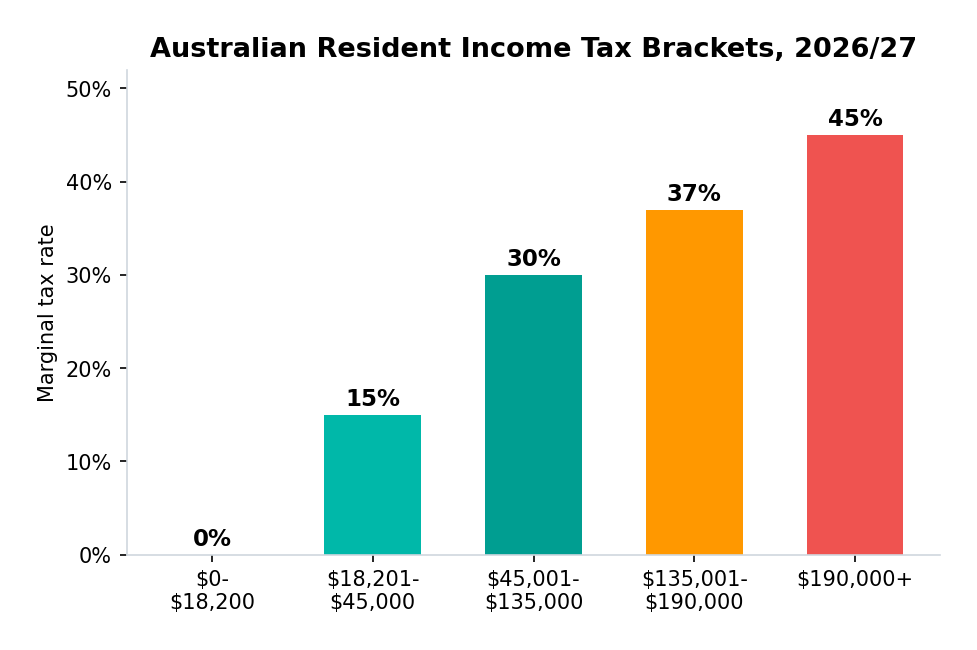
The 15% second bracket is itself news: it dropped from 16% under the Treasury Laws Amendment (More Cost of Living Relief) Act 2025, effective from 1 July 2026. If you were budgeting off last year’s 16% figure, this year’s take-home will be a little higher than you’re expecting.
A worked example: $90,000 salary
Here’s exactly how a $90,000 salary is taxed:
- First $18,200 — taxed at 0% — $0
- Next $26,800 (to $45,000) — taxed at 15% — $4,020
- Remaining $45,000 (to $90,000) — taxed at 30% — $13,500
Total income tax: $17,520. Add the 2% Medicare Levy ($1,800) and your total tax bill is $19,320 — an effective rate of 21.5%, even though your marginal rate (the rate on your next dollar) is 30%. This gap between marginal and effective rate is the single most misunderstood thing about progressive tax, and it’s worth internalising: getting a payrise into the next bracket never makes you worse off overall, because only the income above the threshold is taxed at the higher rate.
The Low Income Tax Offset (LITO)
If your taxable income is under $66,667, you’re also entitled to the Low Income Tax Offset, which further reduces your tax bill:
- Up to $37,500: full $700 offset
- $37,500–$45,000: $700 minus 5 cents for every dollar over $37,500
- $45,000–$66,667: the remainder tapers at 1.5 cents per dollar, reaching nil at $66,667
On a $40,000 salary, for instance, the LITO reduces your tax bill by $575 — a meaningful saving that a lot of “back of envelope” tax estimates miss entirely.
What this doesn’t cover
This guide covers the standard resident case. If you’re a non-resident, a working holiday maker, or you’re self-employed or contracting through a company, the rules diverge meaningfully — see the related articles below.
Want the exact figure for your own salary, including the Medicare Levy, HECS-HELP and superannuation? Our free Australian salary calculator runs the full 2026/27 calculation in your browser — nothing you enter is ever sent anywhere. Every formula behind it is published, with sources, on our How We Work It Out page.