Leaving Australia — even temporarily — can change your tax residency status, and that changes almost everything about how your Australian-sourced income is taxed. Here’s what actually shifts, and why “residency” for tax purposes has surprisingly little to do with your visa.
Tax residency isn’t about your visa
The ATO determines tax residency using a set of tests — the resides test, the domicile test, and the 183-day test are the most commonly applied — that look at where you actually live and your ties to Australia, not your immigration status. It’s entirely possible to hold Australian citizenship and be a non-resident for tax purposes, or to be on a temporary visa and be treated as a resident.
The non-resident rate structure
Non-residents face a fundamentally different rate structure: a flat 30% from the very first dollar up to $135,000, then 37% to $190,000, and 45% above that. There’s no tax-free threshold at all — the $18,200 tax-free band that residents get simply doesn’t exist for non-residents.
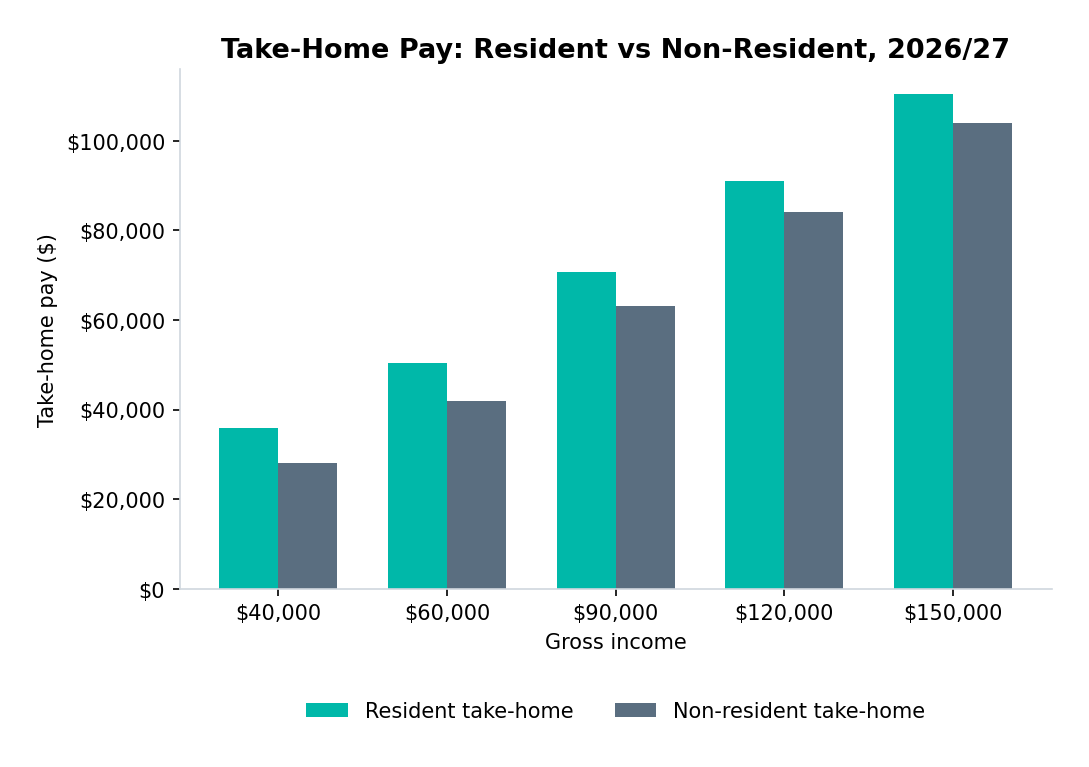
The comparison is most dramatic at lower incomes. A resident earning $40,000 pays roughly $2,695 in tax after the Low Income Tax Offset. A non-resident on the same $40,000 pays a flat 30% — $12,000. At higher incomes the gap narrows considerably, and can even favour non-resident status once you account for the fact that non-residents don’t pay the 2% Medicare Levy.
What non-residents don’t pay
Non-residents are exempt from the Medicare Levy (you’re not eligible for Medicare benefits) and don’t receive the Low Income Tax Offset, which is restricted to residents. Superannuation Guarantee still applies if you’re working in Australia as an employee, regardless of residency status.
Worldwide income vs Australian-sourced income
This is the trade-off that matters most for anyone considering the move: residents are taxed on their worldwide income, while non-residents are taxed only on Australian-sourced income. If you’re leaving Australia and taking up foreign employment, becoming a non-resident for tax purposes can mean Australia no longer has any claim on that foreign income at all — a materially different position from remaining an Australian tax resident working overseas.
Getting it wrong is expensive both ways
Residency determination is genuinely one of the more contested areas of Australian tax law, and the consequences of getting it wrong run in both directions — wrongly claiming non-resident status when you’re actually still a resident, or vice versa, can mean a materially incorrect return. If your situation isn’t a straightforward “living and working entirely in one country,” it’s worth a conversation with a registered tax agent before you file.
See exactly how residency status changes your take-home pay with our free calculator — switch between resident, non-resident and working holiday maker to compare side by side.