If you’re in Australia on a 417 or 462 working holiday visa, your tax situation is genuinely different from both an ordinary resident’s and a non-resident’s — and getting it wrong (or having an employer get it wrong) is a common way people end up with an unexpected tax bill at year end.
The working holiday maker rate
Working holiday makers are taxed at a flat 15% on the first $45,000 of income, regardless of how much you earn — there’s no tax-free threshold the way an ordinary resident gets. Above $45,000, you move onto the standard non-resident scale: 30% to $135,000, 37% to $190,000, and 45% above that.
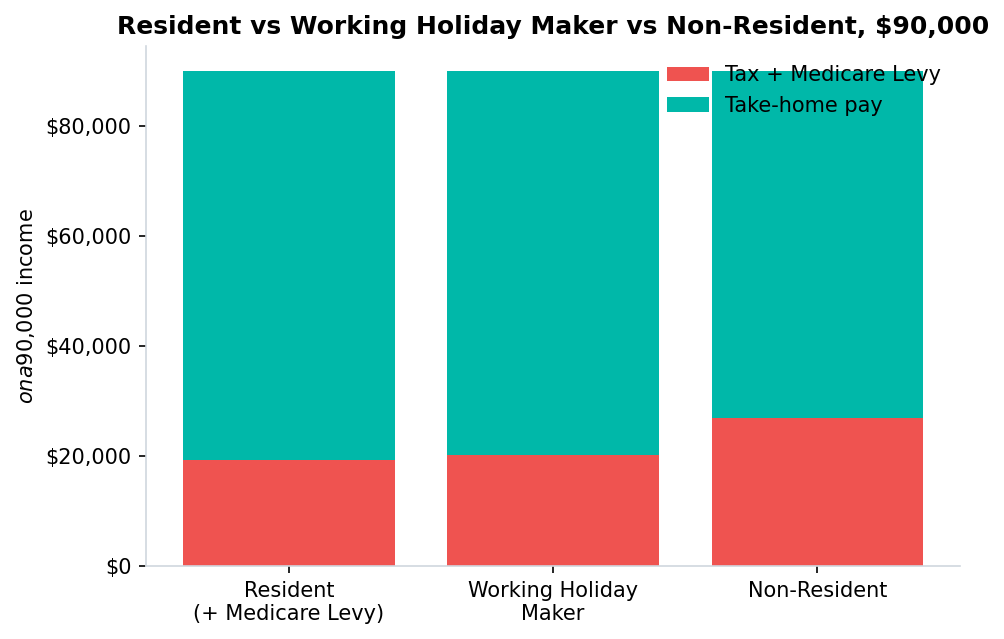
On a $90,000 income, the difference is stark: a working holiday maker pays $20,250 in tax ($45,000 × 15% + $45,000 × 30%), compared to a resident’s $17,520 plus $1,800 Medicare Levy ($19,320 total). The gap looks small at this income level, but it flips at lower incomes — a resident earning $20,000 pays almost nothing thanks to the tax-free threshold, while a working holiday maker on the same income pays a flat 15% ($3,000) from the very first dollar.
No Medicare Levy, no LITO
Working holiday makers don’t pay the Medicare Levy (since you’re not eligible for Medicare benefits) and don’t get the Low Income Tax Offset, which is only available to residents. This is one of the few places where the WHM rate structure actually works in your favour — at higher incomes, avoiding the 2% Medicare Levy partly offsets the lack of a tax-free threshold.
Superannuation still applies
Your employer still pays the 12% Superannuation Guarantee on your behalf, same as any other employee. When you leave Australia permanently, you can claim this back via the Departing Australia Superannuation Payment (DASP) — though be aware DASP withholds a substantial 65% for working holiday makers specifically, so don’t count on getting the full balance back.
Which employer rate should apply to you?
Employers need to register with the ATO as an employer of working holiday makers to apply the correct 15% withholding rate. If your employer hasn’t registered, they may withhold at the higher standard non-resident rate instead — worth checking your payslip against the numbers here if something looks off.
Run your own numbers with our free salary calculator — select “Working holiday maker” under residency to see your exact take-home pay.