If you’re paid through dividends — most commonly as a limited company contractor or director — 2026/27’s rates and allowance are worth knowing precisely, since they sit separately from Income Tax bands entirely.
The dividend allowance
The first £500 of dividend income each year is tax-free, regardless of what other income you have.
The rates above that
Above the allowance, dividends are taxed at 8.75% within the basic rate band, 33.75% within the higher rate band, and 39.35% within the additional rate band — all noticeably lower than the equivalent Income Tax rates, which is exactly why dividends remain a common part of how limited company directors structure their pay.
Worked example
A director taking £40,000 in dividends, with no other income, pays no tax on the first £12,570 (covered by the Personal Allowance, assuming no salary uses it up), nothing on the next £500 (dividend allowance), then 8.75% on the remainder within the basic rate band.
See how salary and dividends combine for your own numbers with the Payslp contractor calculator.
Rates at a glance
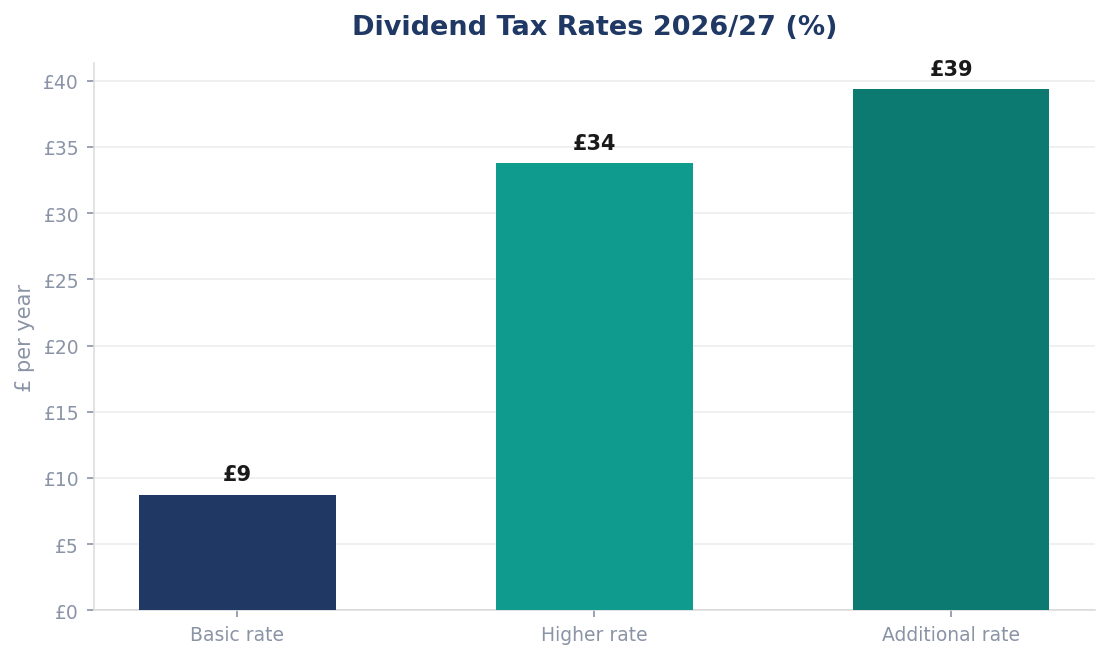
The gap between each dividend rate and its Income Tax equivalent is exactly why dividends remain part of how many limited company directors structure their pay — though the gap has narrowed in recent years as rates have been adjusted.
Frequently asked questions
Do I pay National Insurance on dividends?
No — dividends are entirely outside the National Insurance system, which is one of the structural reasons they’re often more tax-efficient than salary for company directors.
Does the £500 allowance apply per person or per company?
Per person — it’s part of your personal tax allowances, usable regardless of how many companies you receive dividends from.